2014 Another Year of Water Pollution Disasters

From sea to shining sea, all year long, the news overflowed with stories of catastrophic water pollution events that made people sick, destroyed ecosystems and cost uncalculated billions to clean up. The poisons are many – everything from naturally occurring gases released by mining to dumped dry-cleaning solvents and coal ash used as landfill.
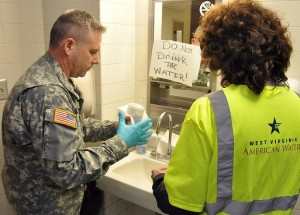
2014 started with four states (Ohio, Pennsylvania, Texas and West Virginia) finally confirming that fracking was responsible for contaminating water wells. Four days later, a disastrous Jan. 9 coal-washing chemical tank leak in West Virginia sickened hundreds of people. Incidentally, the same site was responsible for a similar chemical spill six months later.

By the time it was revealed on Dec. 29 coal ash was the source of water contamination in Wisconsin, so many environmental calamities occurred during the year that it is impossible to list them all here. Unless you’re one of the unfortunate residents affected, these stories are usually quickly forgotten among the stream of assaults against Mother Earth.

Here, briefly, are a few of the hugest water-pollution stories topping the news in 2014:

Winter

  • 4 States Confirm Water Pollution From Drilling  USA Today reported Jan. 5 that an Associated Press investigation revealed water wells in Ohio, Pennsylvania, Texas and West Virginia have been contaminated by oil or gas drilling, despite industry claims that such problems are rare.
  • Toxic Chemical Leaks into Elk River Upriver from the West Virginia American Water intake source, about 10,000 gallons coal-washing chemical, crude 4-methylcyclohexanemethanol, leaked from a Freedom Industries’ holding tank into the Elk River, leaving 300,000 people without potable water for weeks. It was later uncovered that a second chemical also leaked into the river. Industry executives were charged in December.

Spring

  • Freedom Industries Leaks Chemicals, Again A faulty sump pump was blamed for causing potentially contaminated storm water to overflow into the Elk River from a containment trench at Freedom Industries’ site in Kanawha County, W. Virginia, in June — the same site that leaked chemicals into the river in January, poisoning the drinking water supply downstream.

Summer

  • Toledo Water Contaminated by Algae In early August, in the warm, still waters of Lake Erie, chemicals (likely from fertilizer components) caused a massive algal bloom that polluted the drinking water for hundreds of thousands of residents.

Fall

  • Study Links Water Contamination To Fracking In September, University of Texas researchers found  that levels of arsenic, selenium and strontium were higher than the EPA’s limits in some private wells near natural gas wells. A drinking water study by the National Academy of Sciences determined  fracking was indeed responsible for water contamination in several states. In New Mexico alone, the report states,  chemicals from oil and gas waste pits contaminated water sources at least 421 times. In August, Pennsylvania made 243 cases of contamination of private drinking wells from oil and gas drilling operations public.


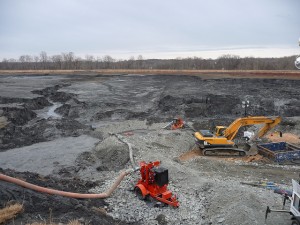
  • Coal Ash Contaminates Wisconsin Water A decades’ long practice of legally dumping tons of coal ash in lots, waterways, landfills, and even hospital parking lots, has been linked to well contamination, according to a study released in November by Clean Wisconsin, an environmental advocacy group. Government programs, such as “beneficial reuse,” allowed power plants to use coal ash as fill in construction projects. Chemicals leaching from the ash may be responsible for numerous serious health problems. The EPA confirmed 157 cases of proven or potential damage from coal ash, including 14 in Wisconsin.
Winter, again

  • West Wichita Wells Contaminated by Dumped Solvents In December, nearly 200 homes in west Wichita were connected to city water as the result of groundwater contamination caused decades ago by dry-cleaning solvents. Kansas Department of Health and Environment spent more than $2.5 million to pay for water mains, meters and connections to the homes that were within the area of the contamination plume.

To get an idea of the potential contaminants in your drinking water, see this report by the Environmental Working Group that compiled records from 48,000 public water suppliers, creating the largest drinking water quality database in existence. More than 300 pollutants were detected. To use the database online, simply enter your zip code to see the results of public water sources near you.

EWG also compiled a water filter resource guide to help consumers choose a system.

To find information about the many water filtration products that we carry, please visit the Highwater Filters website.

 

Posted in Drinking water, Environmental, News, Water | Tagged , , | Comments Off on 2014 Another Year of Water Pollution Disasters

PEX Pipe and Water Quality

Yet another reason to filter your drinking water

From the mid-1800s to the early 1900s, numerous reports documented the health dangers of lead pipes. Although not until the 1920s, many U.S. cities eventually banned or restricted the use of lead pipes for water distribution. Meanwhile, efforts by the Lead Industries Association, which formed in 1928, encouraged cities and homeowners to continue installing lead pipes, extolling lead’s virtues over iron pipe (malleability and increased system longevity).

A century later, consumers question the safety of current popular pipe materials including cross-linked polyethylene (PEX) flexible piping used by a growing number of green homebuilders. Touted for economy and easy installation, whispers of concern have dogged the green home industry. Do chemicals leach into drinking water when stagnant in the pipe or when it’s used for hot water applications?

Consider piping as a vessel. We wouldn’t drink from a lead cup, would we?

Government oversight

When the U.S. Pure Food and Drugs Act passed in 1906, it was 100 years behind public outcries for government oversight of manufacturing. Oddly, the law had no pre-market approval system for food ingredients or drugs. The government could act only after products were on the market.

Before the law, the general attitude was for consumers to be responsible for awareness of potential contaminants. A 1906 USDA Bureau of Chemistry bulletin instructed housewives how to discern if the milk, cereal or canned beans they purchased contained harmful adulterants.

The bulletin strongly defended manufacturers, stating it would not be in their interest to shorten the lives of their customers nor impair their appetites by knowingly adding poisons. Several more decades passed before ingredient-listing was required, delayed because manufacturers feared scaring off customers or giving away secret recipes, according to the FDA.

Suspected toxins

Americans are again calling for more information about the products they put on or in their bodies. Again, regulation lags for consumer information about materials used to store or otherwise hold food and beverages. It can take decades from the time concerns about harmful ingredients arise until any government actions are taken to remove carcinogenic or toxic-containing products from the market. In some cases, there is simply no regulation of contaminants, such as is the case for bottled water sold in the United States.

How many years did we drink soda from plastic bottles containing Bisphenol-A (BPA) before we realized that once in our system, the synthetic chemical compound emulates estrogen? To learn more about bottled water, BPA and water filters, see this 2013 Highwater Marks blog.

First developed in 1891, BPA began appearing in plastic products worldwide in the 1950s. For 60 years, BPA has been used without regulation establishing its safety. The Toxic Substances Control Act passed in 1976, but labeled BPA a “grandfather” chemical, meaning it was never evaluated and was presumed safe by the Environmental Protection Agency, according to research by consumer law firm Baum, Hedlund, Aristei and Goldman, PC. The U.S. Centers for Disease Control and Prevention and American Medical Journal cite numerous health problems associated with BPA use.

The latest “best” piping material

So, is it any surprise that pipe commonly used to transport drinking water into our homes may also leach toxins into that water – and we don’t have to be made aware of it? Under scrutiny recently is PEX potable water pipe.

PEX has several advantages over metal pipe (copper, iron, lead) or rigid plastic pipe (PVC, CPVC, ABS) systems. It is flexible, resistant to scale and chlorine, doesn’t corrode or develop pinholes, is faster to install than metal or rigid plastic, and has fewer connections and fittings, according to PEXinfo.com.

Europeans began using PEX around 1970; it was introduced in the United States in 1980. PEX use has been increasing ever since, replacing copper pipe in many applications, especially for hot water.

Several California groups blocked adoption of PEX for a decade for concerns about toxins getting into the water, either from chemicals outside or inside the pipes such as methyl tertiary butyl ether (MTBE) and tertiary butyl alcohol. California eventually permitted PEX use in all occupancies. An environmental impact report and subsequent studies determined there were no causes for concerns about public health from PEX piping use.

PEX pipe studies

A 2002 Regional Food Control Authority report, “Volatile organic components migrating from plastic pipes (HDPE, PEX and PVC) into drinking water,” by a research team in Norway indicates VOC migrated in significant amounts into the test water from PEX pipes. The full report is available for purchase online.

A 2014 study by University of South Alabama graduate student Matt Connell presented new drinking water impact results regarding plastic pipes in green buildings. At an American Water Works Association conference, Connell discussed the degree chemicals leach from popular plastic plumbing pipes. Also attending, environmental engineering professor Andrew Whelton described drinking water odor and chemical leaching results for six brands of PEX pipe. Their downloadable presentation is available here.

Following a 28-day study on water quality, including taste and odor and chemical leaching, the researchers concluded that PEX pipes’ test results are highly variable among manufacturers.

“There were wide variations between the magnitude of chemicals released by PEX pipes. One PEX pipe significantly altered drinking water quality while the other did not,” their report states.

Connell and Whelton said little information is available for plastic pipe sold in the United States. “To aid homeowners, builders, and water professionals in their desire to select plumbing pipe that ensures safe and aesthetically pleasing drinking water, more data are needed,” they reported.

“There is a bigger concern in the weeks after installation,” concluded Hilary Ohm, owner of Highwater Filters, after studying the researchers’ reports. “Over time, the dangers are minimal. However, flushing water that has been standing for a period of time and using a filter are the best ways to protect consumers from any harm.”

PEX pipe? There is a filter for that

History indicates consumers would be wise to research piping materials instead of relying on industry professionals or the government for safety and health information. As an added measure, install a water filter and test your water.

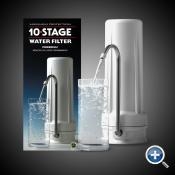
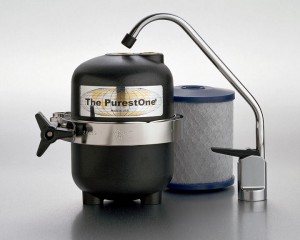
Two products purported to remove the chemicals that leach from PEX (MBTE and VOCs) are the PurestOne and the Premium 10 Stage.

Environmental Protection Agency strongly encourages people to learn more about their drinking water, and to support local efforts to protect the supply of safe drinking water and upgrade the community water system. EPA requires all community water systems to prepare and deliver an annual consumer confidence report, sometimes called a water quality report, to their customers by July 1 of each year. Homeowners with private wells are advised to test their water at least annually or more often if problems are suspected due to odor or nearby activities (fracking, mining, agricultural, etc.)

Posted in Drinking water, Environmental, home water filter systems | Tagged , , , | Comments Off on PEX Pipe and Water Quality

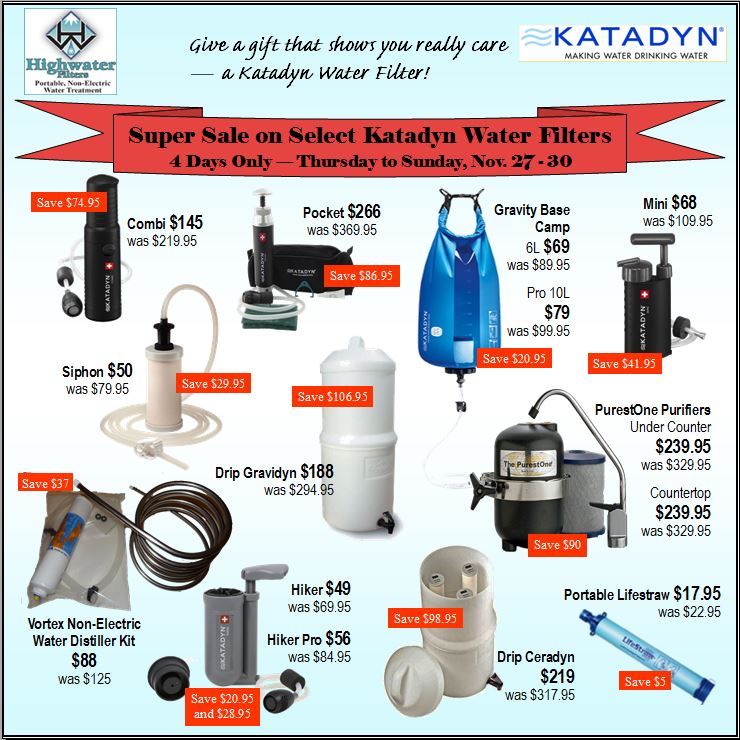
Thanksgiving Weekend Sale at Highwater Filters ~ Black Friday all Weekend Long!

We’ve extended our sale for Cyber Monday. Last day!

Happy Thanksgiving to all our friends. Sale ends Sunday.

Posted in holiday savings, Hot Deals, Katadyn Pocket Water filter sale, Katadyn water filter sale, LifeStraw, Products, Vortex Non-electric Water Distiller Kit by Highwater Filters, Water, water purification | Tagged , , , | Comments Off on Thanksgiving Weekend Sale at Highwater Filters ~ Black Friday all Weekend Long!

Ebola Fear Brings Unreasonable Water Concerns

The Deadly Virus is not a Reason for Filtering Water – but a Host of Other Contaminants Are

Historically, people have occasionally been wide off the mark concerning water cleanliness and safety. Who can forget the iconic “Whites Only” drinking fountains of the last century designed to prevent disease spreading between races?

In the photo below from the Library of Congress archives, a young man is drinking water from a “colored” dispenser at an Oklahoma City streetcar terminal in 1939. Even with paper cups at hand, folks feared they would become ill if using the same water cooler. Many Caucasians actually believed they could catch a multitude of infectious diseases from non-whites while using public restrooms, restaurants, drinking fountains and even transportation waiting areas from only the slightest human contact. This irrational and outright shameful discrimination was aimed not only at Blacks, but also Asians, Native Americans and Hispanics and continued openly until the Civil Rights Act passed in 1964.

Meanwhile, U.S. municipalities and factories nearly killed the Great Lakes and other major waterways with industrial waste, mercury, lead, phosphates and raw sewage. In 1969, the Cayuga River actually caught fire in Cleveland it was so full of flammable chemicals.

“There was a time, not so long ago, when pollution was accepted by many as the price one paid for living in an industrialized society. By the 1960s, our rivers had become so polluted by municipal and industrial wastes that fish could not survive in them and humans could not swim in them; millions of yards of garbage and millions of gallons of oil were routinely being dumped at sea; visibility in our major cities was obscured by smoke from factories and exhaust from automobiles; and industrial wastes, buried in drums and dumped in landfills, was contaminating soil and groundwater.” Source: U.S. Department of Justice, Federal Prosecution of Environmental Pollution Crimes.

This legal dumping went practically unchecked until the 1970s, and continues illegally and accidentally today, as evidenced by news stories of toxic waste spills, too numerous even to list here. Basically, pick a state and you can find a recent, horrific poisonous spill story to accompany it. Yet many trust their water supplies to be safe.

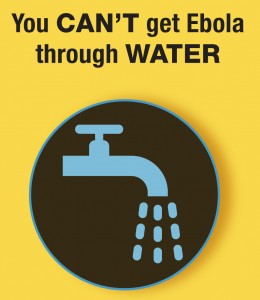
Today, fear of contracting Ebola, or Fearbola, has many panicking and rushing to purchase home water filter systems. Filtered water is, sadly, a wise choice for most of us today, but not because of Ebola. If we can believe the Center for Disease Control reports, the likelihood of contracting Ebola through water sources is nil. According to the CDC, Ebola is not spread through the air, by water, or in general, by food. Even before the first Ebola cases were reported in North America, however, some water filter dealers began marketing their products as Ebola filters, preying on illogical fears.

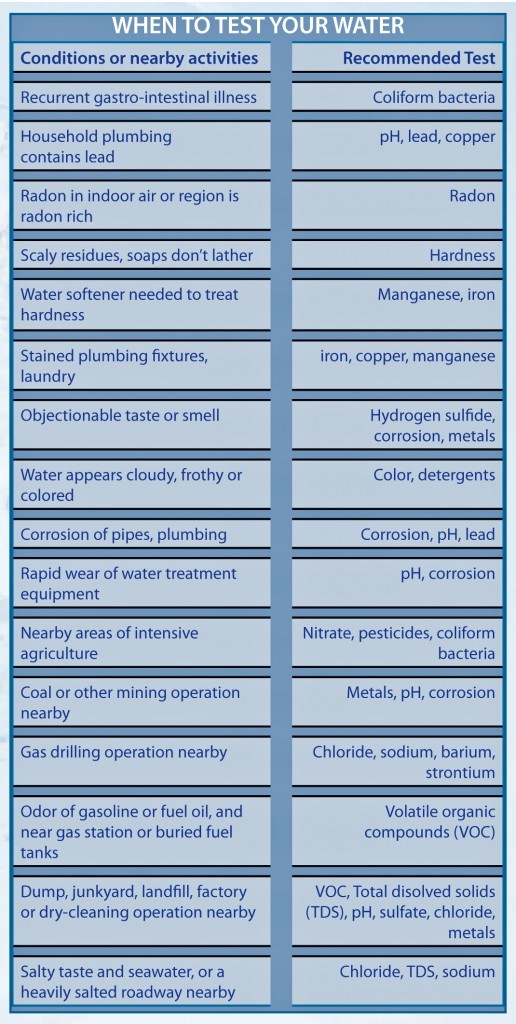
Still, numerous other pollutants are prevalent in our water. These include nitrates, nitrites, pesticides and other agricultural chemicals, parasites, bacteria, lead, mercury and radon, to name a few of the potentially hazardous contaminants lurking silently in private and public water supplies. Simple, at-home water-test kits are available at local department stores. The Environmental Protection Agency compiled this handy chart to list common contaminants.

In short, filter your water to protect your health, but be aware of the actual contaminants.

Check out our website at Highwater Filters for all your water treatment needs. We offer low, low prices, super fast shipping and the best customer service.


Posted in Drinking water, Environmental, Water, water purification | Tagged , , , , | Comments Off on Ebola Fear Brings Unreasonable Water Concerns

Katadyn Labor Day Sale at Highwater Filters! 2 Weeks Only!

Sorry, this sale is over.

All Katadyn water filters are on sale during our annual Labor Day celebration. Don’t miss out on our low, low prices.


Katadyn Pocket marked down to $252!

Check out the bargains here.


Posted in Emergency Preparedness, holiday savings, Hot Deals, Katadyn Pocket Water filter sale, Katadyn water filter sale | Tagged , , , , | Comments Off on Katadyn Labor Day Sale at Highwater Filters! 2 Weeks Only!